AGE Correction Results
Detailed numerical results of AGE re-diagonalisation for temporal modes in waveguide quantum networks
Baseline vs AGE Comparison
Baseline Transfer Matrix
| f0 | f1 | f2 | |
|---|---|---|---|
| f0 | 0.806 | 0.014 | 0.001 |
| f1 | 0.016 | 0.838 | 0.045 |
| f2 | 0.000 | 0.044 | 0.716 |
AGE-Corrected Transfer Matrix
| g0 | g1 | g2 | |
|---|---|---|---|
| g0 | 0.828 | 0.002 | 0.000 |
| g1 | 0.002 | 0.828 | 0.002 |
| g2 | 0.000 | 0.002 | 0.826 |
Channel Parameters
Values used in the baseline simulation for coherent channel distortion
| Parameter | Symbol | Value |
|---|---|---|
| Detuning | δω/(2π) | 1.75 MHz |
| Coupling rate A | κA | 26.7 MHz |
| Coupling rate B | κB | 30.7 MHz |
| Loss | ploss | 17% |
| Shaping amplitude | σshape | 5% |
| Shaping correlation time | τcorr | 5 ns |
| Bandwidth | Γ/(2π) | 24 MHz |
AGE Algorithm Properties
The AGE re-diagonalisation algorithm presents several favorable properties that make it suitable for experimental implementation. The computational cost is minimal: it requires a single 3×3 matrix inversion at calibration time, which is instantaneous on modern hardware. Numerical stability is guaranteed by the good conditioning of the Gram matrix, and Tikhonov regularization is available as a fallback for cases with degraded conditioning.
The maximum amplification |Am,k| = 1.018 is trivial for the AWG, meaning that corrected templates do not require significantly higher pulse powers than the originals. The per-mode template change in L² norm is 13-28%, a range well within the reprogramming capabilities of standard AWGs. The condition number cond(S) = 1.10 confirms that the problem is well-posed and the inversion is stable.
Absorption Matrix A
- Well-conditioned
- cond(S) = 1.10
- Max amplification
- |Am,k| = 1.018
- Loss limit reached
- 0.827 / 0.830 = 99.6%
Distortion Sweep Results
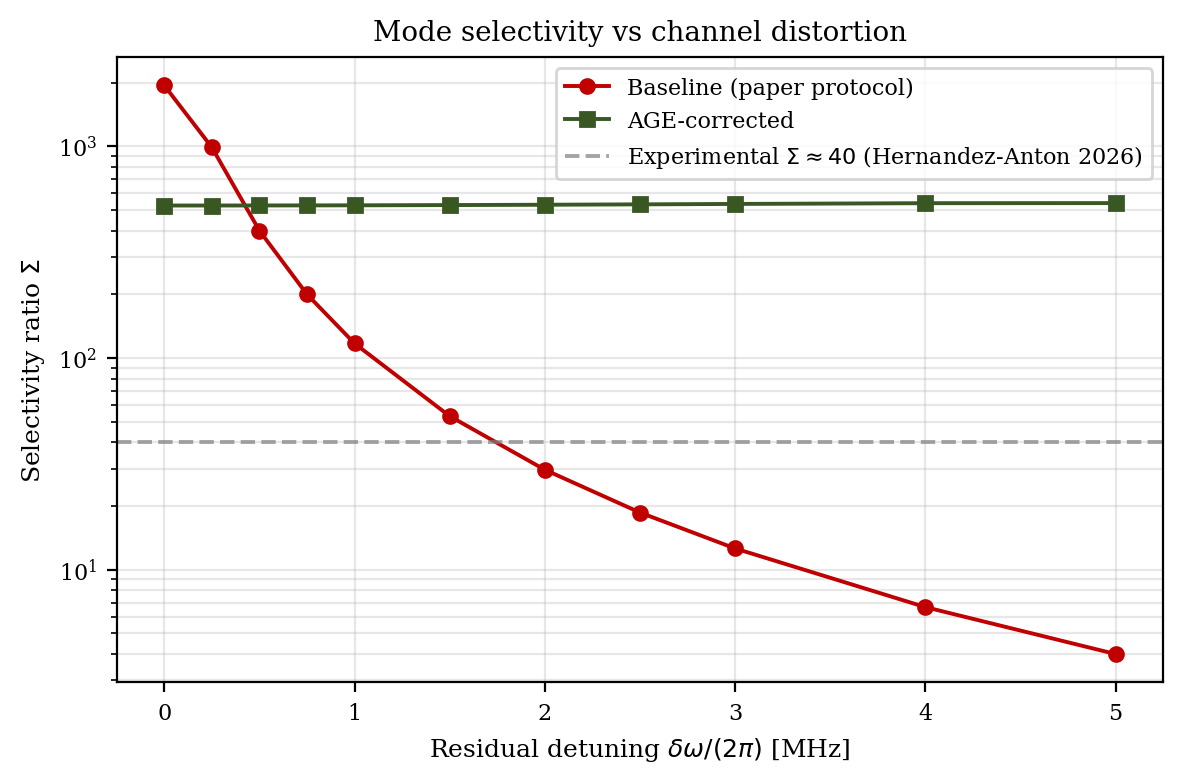
The 1D parameter sweeps reveal the differentiated behavior of AGE correction against different distortion sources. In the detuning sweep (0-5 MHz), baseline selectivity Σ degrades drastically from ~1942 to ~4, while ΣAGE stays approximately constant in the ~525-540 range. This stability demonstrates that AGE effectively compensates detuning regardless of its magnitude within the studied range.
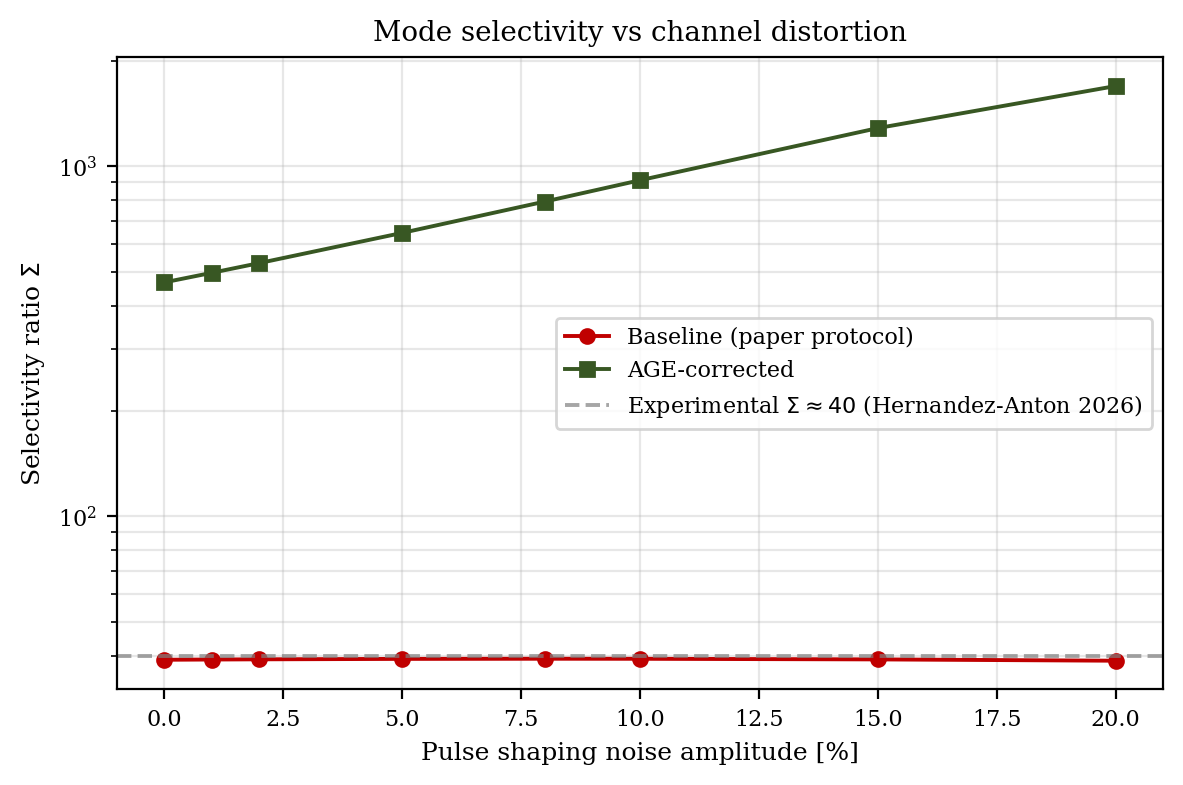
In the shaping error sweep (0-20%), baseline selectivity remains nearly flat (~38-39), as shaping errors alone do not significantly break orthogonality. However, ΣAGE increases with shaping (466→1697), a counterintuitive effect explained by the fact that additional distortions provide more information for the AGE algorithm to optimize absorption templates.
2D Robustness Map
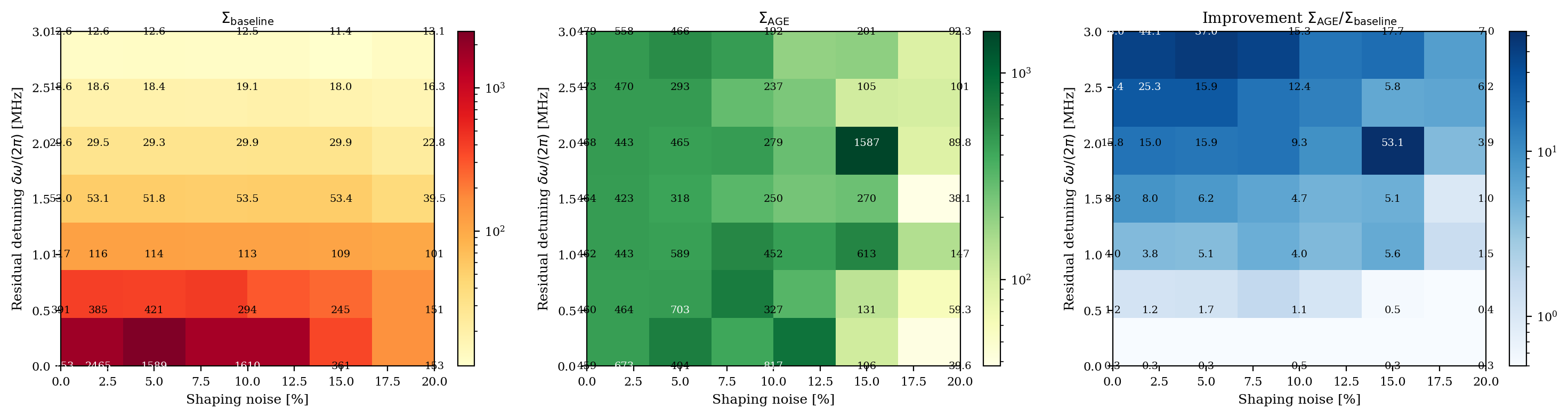
The 2D parameter sweep across 42 operating points shows AGE correction is robust across a wide range of channel conditions. The maximum improvement is 53.1× at (2.0 MHz, 15% shaping), where baseline selectivity has severely collapsed but AGE maintains high selectivity. This result is particularly important because it demonstrates that AGE correction is most valuable in high-distortion regimes where it is needed most.
At zero distortion, AGE can slightly hurt selectivity (improvement < 1×) since modes are already near-orthogonal and the correction introduces minor numerical degradation. At strong distortion (δω = 3 MHz), improvement reaches up to 44×, confirming the scalability of the benefit with channel severity. This smooth transition between regimes confirms the algorithm stability across the entire parameter space.
Limitations & Extensions
Limitations
- Does NOT correct loss: loss remains at 17% regardless of AGE correction. Re-diagonalisation only restores mode orthogonality, it cannot recover photons lost in the channel.
- Phenomenological model: a phenomenological channel model is used that has not been validated against experimental superconducting chip data. Transferability to real hardware requires experimental verification.
- K=3 modes only: the demonstration is limited to K=3 temporal modes. Scalability to K>3 requires additional analysis of Gram matrix conditioning.
- Non-Markovian effects: non-Markovian memory effects in the channel are not considered, which could be relevant for waveguide networks with parasitic reflections.
Extensions
- More modes (K>3): extension to higher-dimensional mode spaces to increase temporal encoding capacity per photon.
- Cascaded networks: application of AGE to multi-node cascaded networks, where distortions accumulate along the chain.
- Multiplexed encoding: combination of temporal modes with frequency or polarization encoding for hybrid quantum multiplexing.
- Optical network adaptation: translation of the AGE framework to fiber optical networks, where distortion sources differ (chromatic dispersion, PMD).
- Experimental validation: verification on real superconducting chip to confirm the numerical predictions of the phenomenological model.
Computational Reproducibility
All results presented on this page are fully reproducible using the age_temporal_modes Python package. The package includes complete benchmark scripts, input data, and simulation parameters used. The total runtime is approximately 3 minutes on a standard computer, generating all figures and numerical data presented.
git clone https://github.com/Algebric-Gate-Engine.git
cd AGE_TemporalModes_JGR
pip install -r requirements.txt
bash scripts/run_all_temporal_benchmarks.sh
The repository includes complete documentation, unit tests, and Jupyter notebooks for interactive exploration of results. Output data is generated in JSON format to facilitate independent verification and further analysis.
View on GitHubage_temporal_modes
- Language
- Python 3
- Dependencies
- NumPy, SciPy, Matplotlib
- Runtime
- ~3 minutes
- Output format
- JSON + PNG
- Licencia
- MIT
Reference Data
Download the complete parameter sweep and AGE correction data for independent verification.